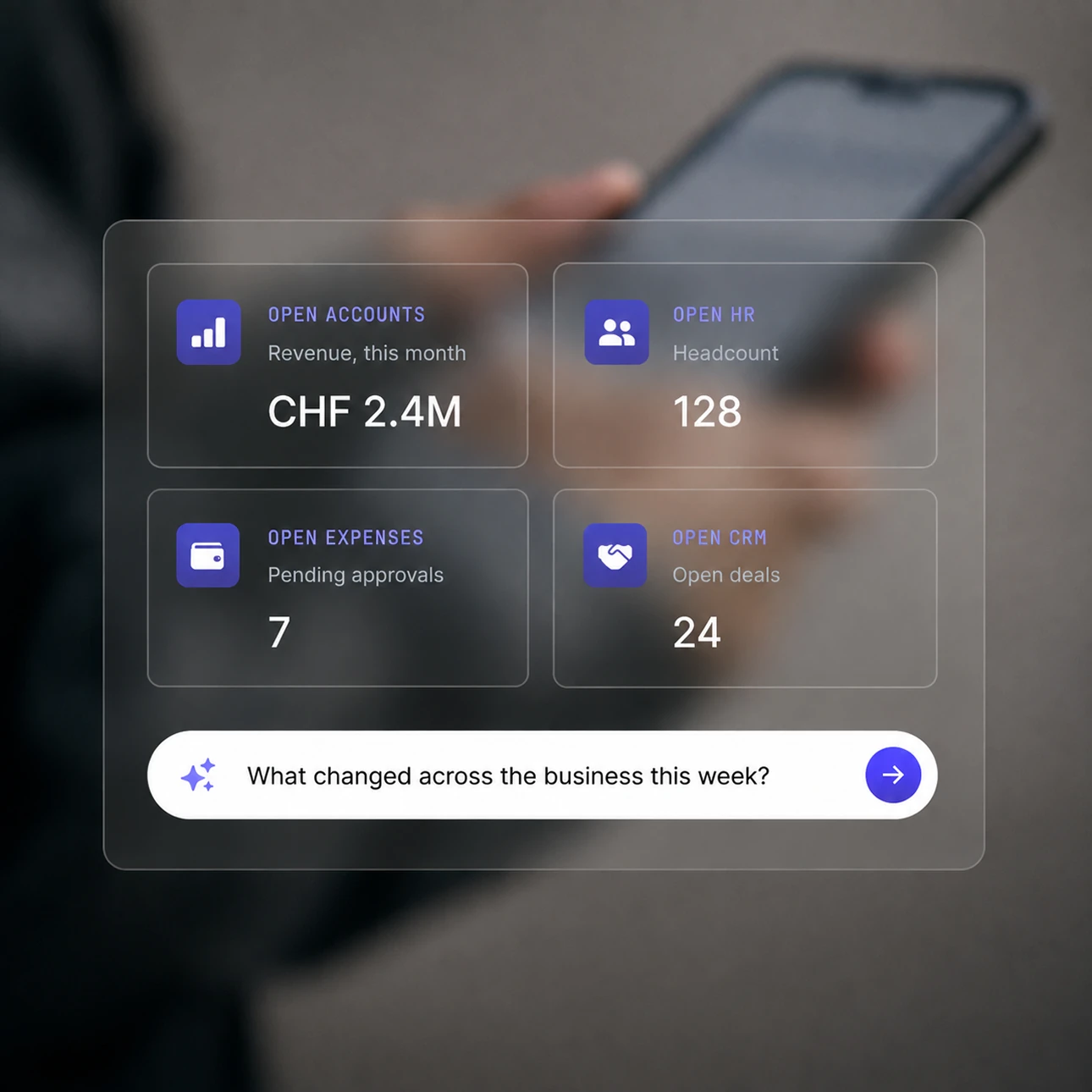
Seven infrastructure nodes are picked out of the global pool, one on each inhabited continent: Ashburn, São Paulo, Frankfurt, Johannesburg, Mumbai, Singapore and Sydney, each from a different provider. They become one tamperproof Cloud Engine that keeps running when two of them go offline. Coding agents (Claude, Codex, Cursor, Gemini and Perplexity) write Motoko, the first language designed for agents that build, and what they write becomes sixteen services running on the engine, from the OpenSaaS suite (Accounts, HR, Expenses, CRM, Projects, Signing, Calendar, Requests) to the payroll, invoicing, inventory, procurement, support desk, analytics, website and identity a company also needs. Four of them then report what they hold: revenue of CHF 2.4M, up 8%; a headcount of 128, up six; seven expense approvals pending, the oldest two days old; and 24 open deals. Those are the figures behind the answer to a question put to the engine about the business.
You choose the replica nodes, they combine over the internet to create a tamperproof and unstoppable, sovereign cloud platformCreate custom solutions on-demand — the world's first serverless coding environment for agents, and the production of advanced AIwareSaaS should be free. SaaS should be AIware. Get off your legacy SaaS, save money, and unleash the power of AI within your enterprise
Combine on-prem, hyperscaler and independently provided hardwareA new kind of software framework for a new kind of software engineerInstalling Open SaaS on cloud engines is as easy as running phone apps
Ship complex systems. Your engine handles the rest.
A cloud engine is not a server, not a serverless runtime, and not a managed Kubernetes cluster. It is a virtual compute platform created by a sovereign network of nodes combined by a mathematically secure network protocol. The difference matters for every enterprise and government that wants to run modern AIware apps and services without the headache.
01tamperproof execution
Run services as easily as phone apps.
Cloud engines are serverless virtual execution environments hosted by mathematically secure networks. There's no vulnerable OS or servers, no firewall to maintain, just apps composed from tamperproof software logic and memory running on hackproof infrastructure.
02fault tolerance
Nodes can fail. Cloud engines can't.
Cloud engines symmetrically replicate computation and data across their underlying compute nodes. Redundancy, combined with protocol math, enables them to withstand everything from nodes going offline, to nodes being compromised.
03orthogonal persistence
The Program is The Database.
If software ran forever, there would be no need for databases, as data could live inside software variables, records, and collections. This is the 'orthogonal persistence' of cloud engines, which massively simplifies backend software.
04upgrade safety
A lossy update never ships.
The Motoko language's serverless framework can detect when an update to software would cause data loss, perhaps because the migration logic was lossy, and rejects the change. Your AI tries again. Your customers never notice.
Scaling is another complexity that cloud engines help you address. Adding new nodes horizontally scales query workloads. Meanwhile, upgrading nodes scales-up data updating workloads, while splitting cloud engines can horizontally scale them.
06portability
Swap the nodes, no downtime.
A cloud engine floats over its underlying compute nodes, which can be added and removed at will. For example, if a cloud engine runs over Big Tech cloud A, it can be moved to cloud B, or sovereign hardware, without interrupting hosted apps.
You choose the nodes. You choose who runs them, where they run, and what class of nodes to use. The Internet Computer's autonomous governance system, and Internet Computer Protocol do the rest, combining your nodes into a symmetric replicated execution environment that your agent-built applications run on.
Because the engine is a configuration, it can be changed without interrupting compute. Add new nodes, remove old ones, change operators or geographies. Your apps do not notice the substrate moving beneath them.
Apps with no specific residency requirement. Picks from the widest provider pool.
Residency
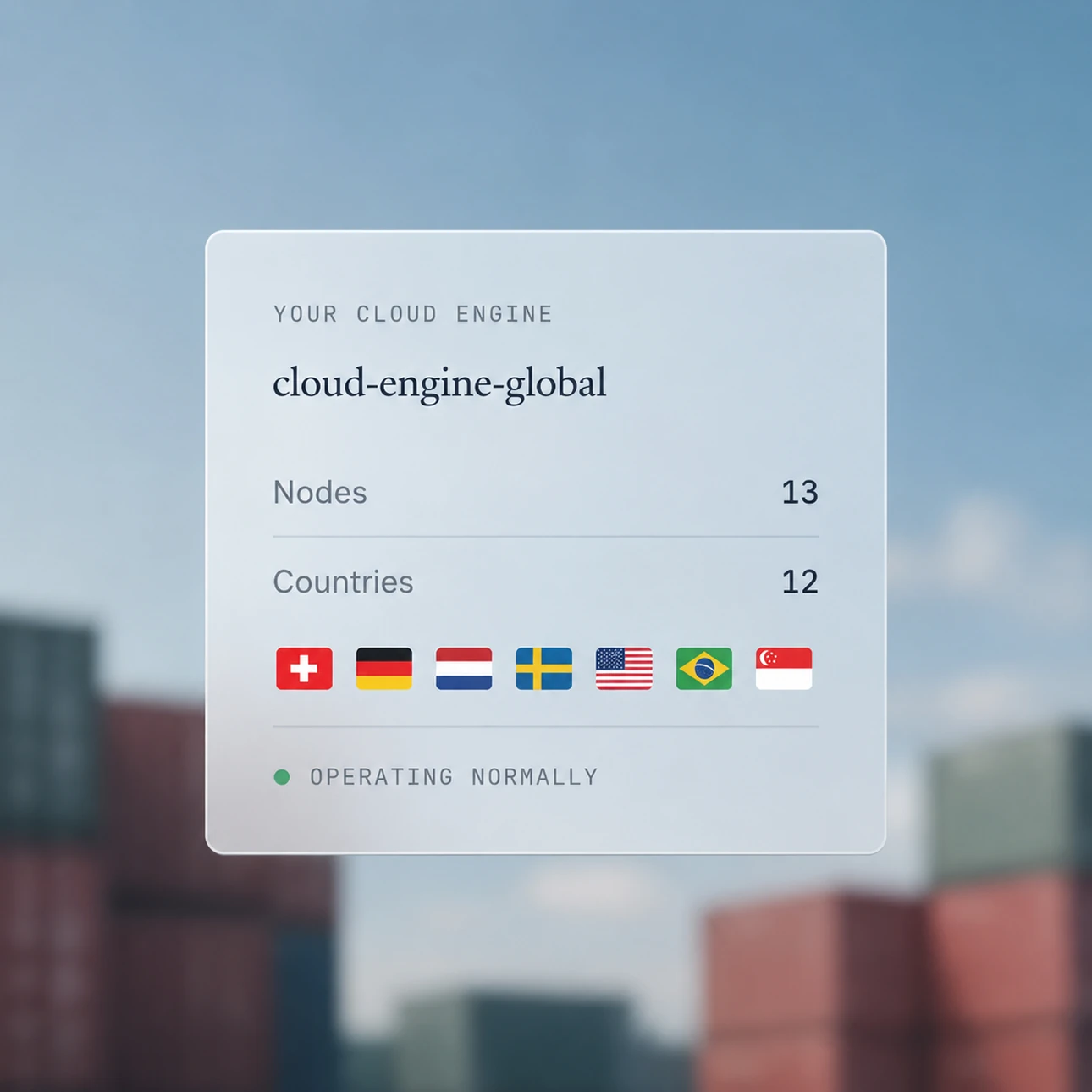
12 countries · 6 continents
USCABRIEDECHSEZAINSGJPAU
Engine
13 nodes · Performance
Fault tolerance
4 of 13 nodes can fail, and the engine keeps running
04 independent node providers
Choose the hands on your hardware.
1,424 nodes are ready to join an engine, from 20 independent providers in 36 datacentres across 12 countries. Every one is verified, auditable, and individually selectable — pick by operator, geography, datacentre or hardware class, one node at a time.
1,424Nodes ready
20Independent providers
36Datacentres
12Countries
ProviderNodes readyDatacentresLocationNode class
DS
DFINITY Stiftung
Virtual and cloud · 7 AWS regions, 4 independent sites
A key challenge with apps built on traditional tech is that when updates are made, the migration of data from old to new formats can result in loss. Traditionally, a systems administration team stands on hand to reverse updates in such situations. But agents want to build autonomously, often at the speed of conversation. On cloud engines, ICP and the Motoko language prevent migration mistakes occurring.
Currentv2.4
Running
Upgrade check
Upgrade prepared✓
State compatibility✓
Lossless migration✕
Unsafe upgrade detected M0170
Candidatev2.5
Rejected ✕
Unsafe upgrade blockedv2.4 remains live
06 OpenSaaS suite Coming soon
Stop renting your business software.
AI-native "AIware" business apps for accounting, HR, mail, expenses, projects, CRM and more. Open source services you can remix, where you own your data, on cloud engines you configure, where services evolve through the same checked upgrades.
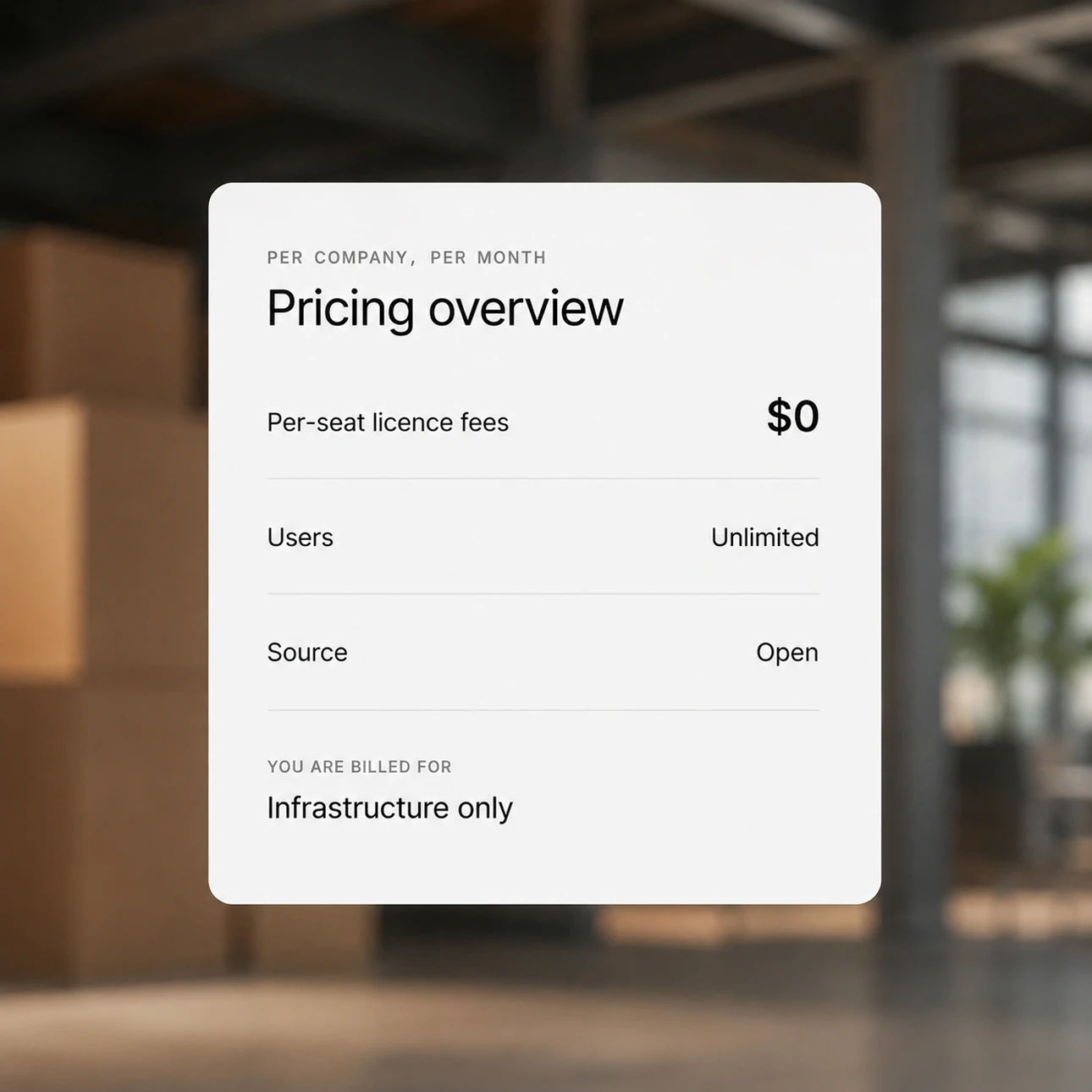
Your enterprise owns its own services. No per-seat Open SaaS licence fees. Infrastructure is billed separately, so what you pay follows the workload rather than the headcount.
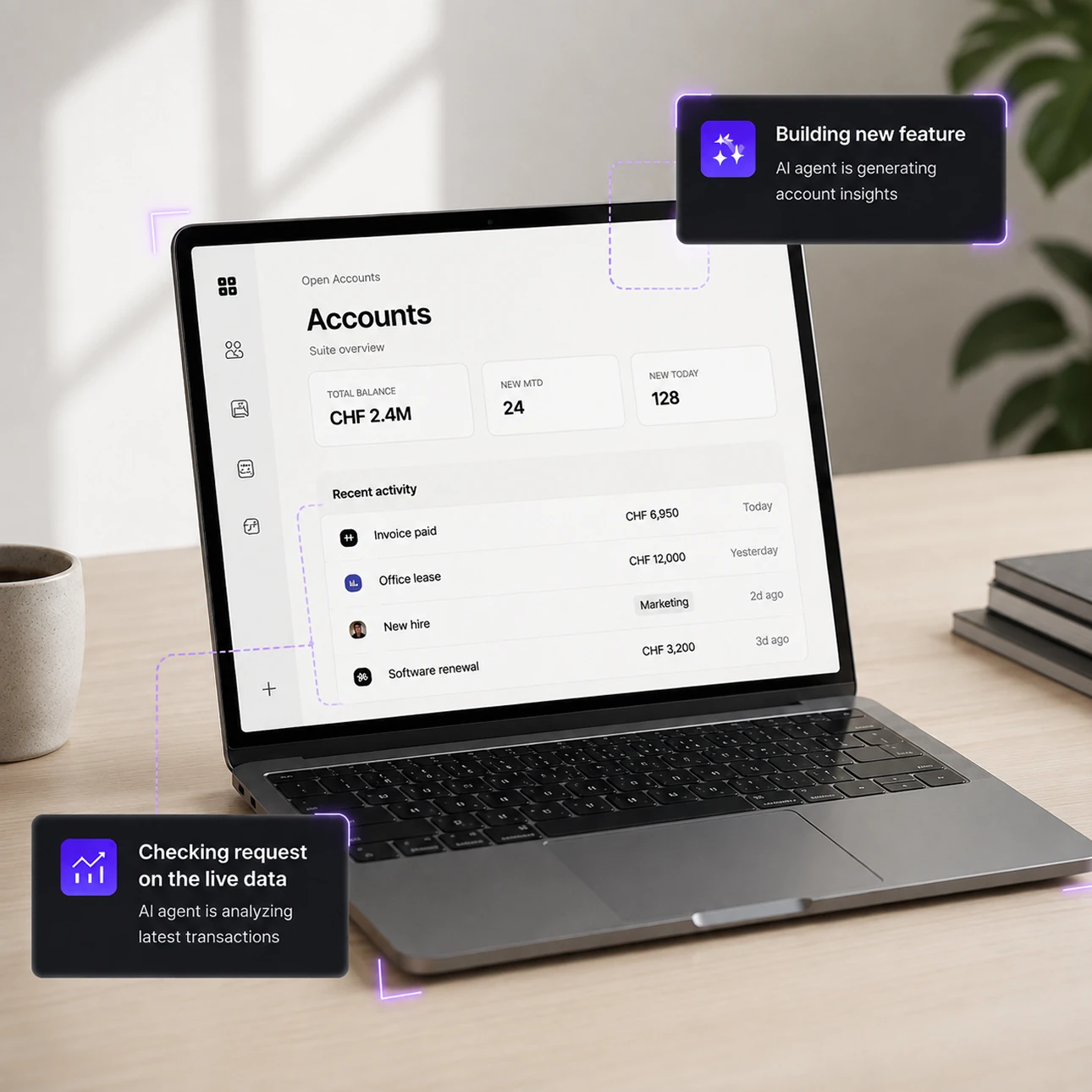
Your agents extend a working suite. Nineteen apps for accounting, HR, mail, expenses, projects and CRM, so an agent starts from software that already runs instead of an empty project.
One question crosses the whole business. Install applications individually or as a connected suite. Because they share one live memory state, an answer can come from accounting, HR and CRM at once.
They run on the engine you chose. The same nodes, providers and countries you picked, under the same residency as everything else you deploy there.
07 Apply for early access
Host apps on frontier compute infrastructure designed for the AI era.
Use opencloud.org to create sovereign frontier cloud networks that are part of the Internet Computer network. Your apps. Your nodes. Your rules. Unleash your agents in a secure environment made safe by guardrails.

 Built in Motoko
 Open Accounts
 Open HR
 Open Expenses
 Open CRM
 Open Projects
 Open Calendar
 Open Signing
 Open Requests
 Payroll
 Invoicing
 Procurement
 Inventory
 Support desk
 Website
 Analytics
 Identity


 CA
CA IE
IE CH
CH SE
SE JP
JP